
Driving for Better Business’ monthly fleet focus delves deeper into some of the key road safety topics to improve your understanding, with free resources for you to share with your drivers.
This month’s fleet focus highlights Operation Tramline, a National Highways road safety initiative.
What is Operation Tramline?
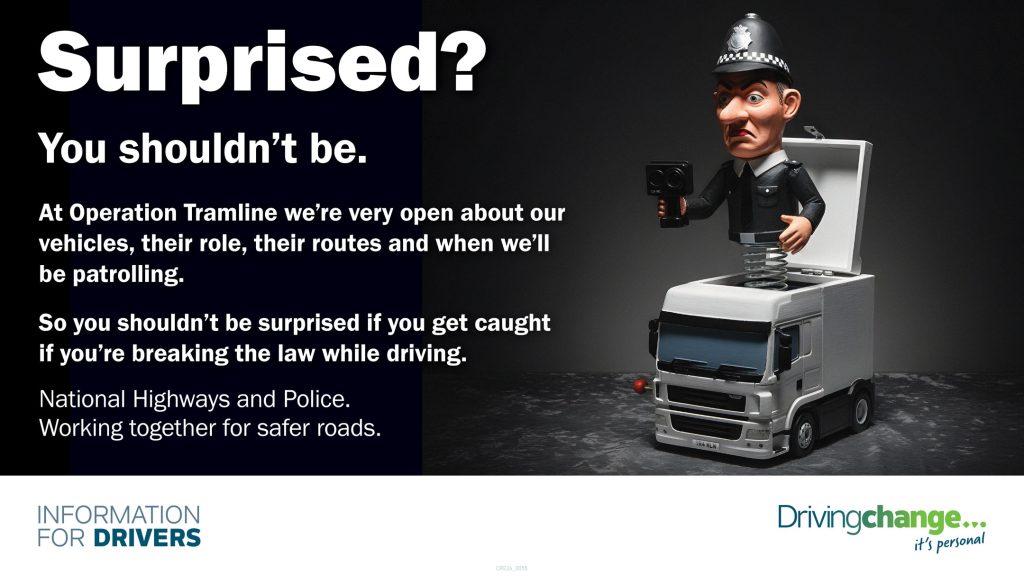
Operation Tramline is a National Highways road safety initiative. It has three plain HGV cabs which it lends to police forces around the country to help them keep you safe from dangerous drivers. You can find out what regions are using the Operation Tramline cabs at any time on National Highways calendar.
Driving is the riskiest thing you do in your working day. So whether you are a vocational driver, or simply drive as part of your job, it’s important that you can do it in safety. The Tramline cabs give police officers the best chance of seeing what drivers are actually doing because of their elevated position.
The use of HGV cabs doesn’t mean they only target HGV drivers. In fact 60% of the drivers asked to stop for a chat by police during Tramline shifts are in vans or cars.
You know only too well that some drivers do really dangerous things when driving – and you are one of the people they are putting at risk. Sometimes the police just offer advice, and often they issue penalty notices or even, in extreme cases, arrest individuals.
Some people do extraordinary things when driving – such as standing on their seat to fetch their sandwiches, or having a huge plasma TV on the dashboard. Breathtaking as that is, the most common offences are also really dangerous – using a handheld mobile phone, driving erratically, tailgating, or simply not having their mind on the job.
Over the last 12 months the police have intercepted drivers committing almost 12,000 offences and have offered advice to even more drivers. The most common offences included 3,602 incidents of handheld mobile phone use and almost 3,000 incidents where drivers weren’t wearing their seat belt.
In total, almost 11,000 vehicles which were causing serious and unnecessary risk on the road were stopped during Operation Tramline over the past year.
How it works
Currently 32 polices forces in England and Wales use the Tramline cabs.
When using Operation Tramline, the police usually have a team of four or more officers. Two will be in the cab – one to drive and one to watch out for risky driving. The observer will usually have a video camera, so that they can show the driver exactly why they have been stopped and, if necessary, use the footage as evidence.
There will also be one or two response vehicles, depending on the resources available on the day. The response vehicles are in constant contact with the HGV. Their role is to ask the offending driver to pull over so they can discuss their driving, and if they are sure the observed behaviour was in fact illegal or dangerous, they can take action.
The great news is that Tramline works. We know this because the police forces report their findings from each shift with the vehicle back to National Highways. Having run Operation Tramline for ten years, National Highways now sometimes gets reports where police have found no wrongdoing at all on their stretch of the motorways during their shift. This might be a little boring for the coppers, but it’s great news for road safety!
So if you see your local force out in one of the Operation Tramline cabs, give them a wave. They are doing their best to keep you safe, and dangerous drivers off the road.