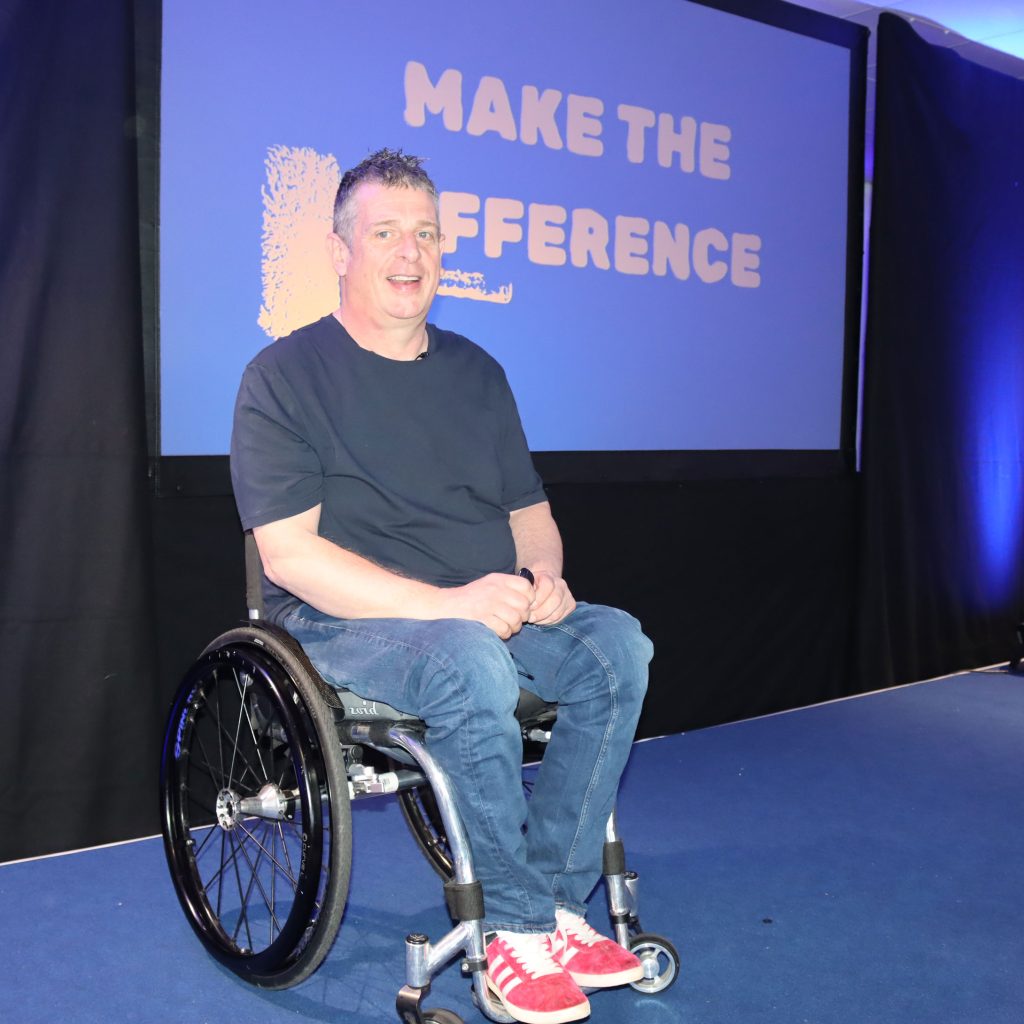
Every year people suffer serious, life changing injuries, or worse, as a result of falling from height, an activity that takes place every day in construction and more specifically, within the painting and decorating sector.
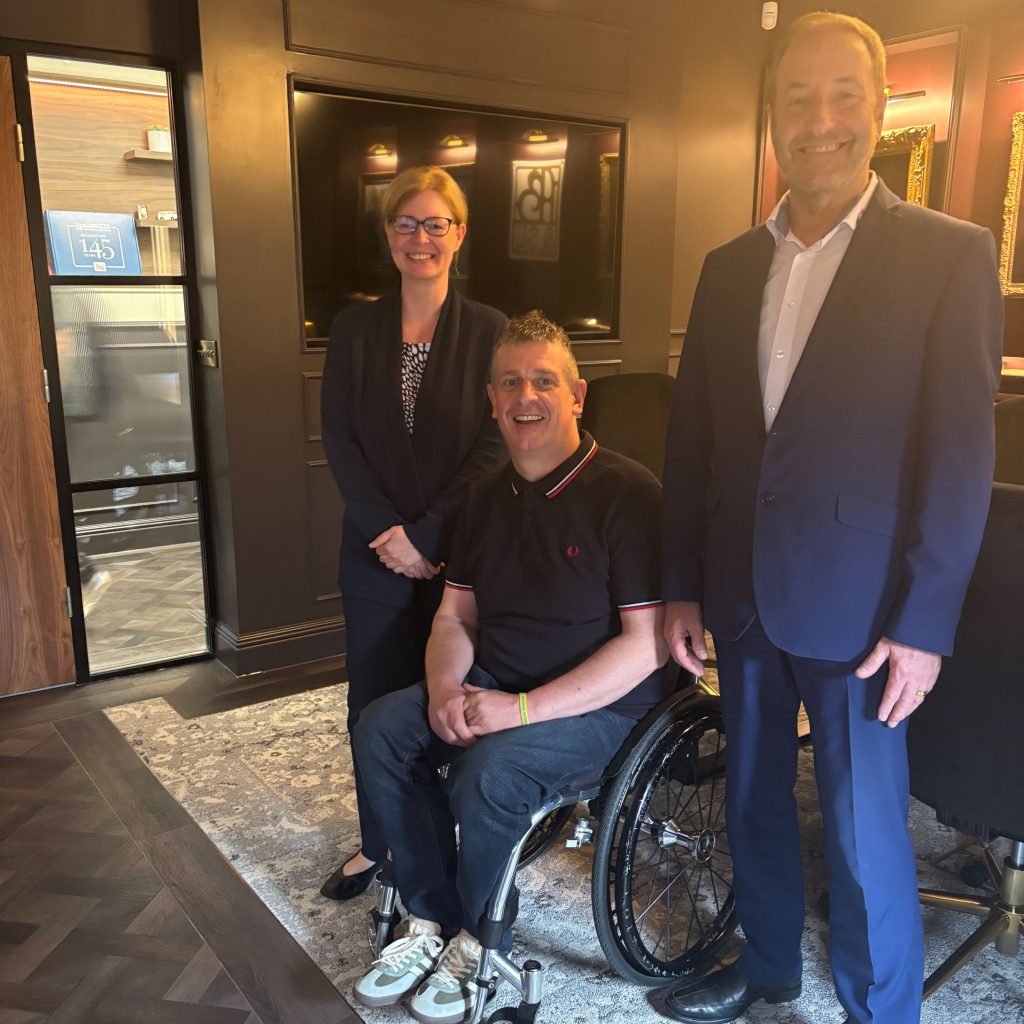
Jason Anker is one of those people. On the 3rd January 1993, whilst working as a labourer for his father-in-law’s roofing company, Jason suffered a life changing injury when he fell from a ladder at the age of 24. Recently Becky Slater, PDA SHE committee member and Head of SHEQ at Bagnalls, Neil Ogilvie, PDA CEO and Joanne Gualda, Director at Bagnalls met up with Jason at Bagnalls HQ to talk about his experience, the work he does now and how people should approach working at height.
There are times in life when you are stopped in your tracks…one of those times is hearing Jason share the story of his accident and his subsequent journey. In recent years, Jason has been sharing his experiences globally and developing new approaches to addressing some of the highest risk factors within the workplace.
The accident and immediate aftermath
The accident happened late in the day, was unplanned work and was a last-minute favour for a customer who had a leaking roof. Under pressure to get a 2-hour job done in an hour due to fading light, a ladder was used for access and the job itself was successfully completed. However, whilst coming down the ladder, the ladder slipped and Jason fell to the ground. Initially thinking he’d only suffered minor injuries, Jason realised when he tried to sit up that his legs were numb. After scans in hospital, a specialist confirmed that Jason had suffered a T10 spinal fracture and would never walk again. Following major surgery and 3 months in a rehabilitation hospital, Jason was discharged on April 25th1993. One day later his wife left the family home taking their two young children with her. Not knowing how to deal with this, and with his friends not knowing how to effectively support him, drinking became his coping mechanism.
Jason’s friends and family also struggled to cope with what had happened, resulting in a family rift that took over 20 years to repair, lost friendships and mental health challenges for both Jason and those around him. The impact of the accident doesn’t stop at the physical injuries themselves.
Was the accident avoidable?
Reflecting on his accident Jason acknowledges that at that time, using ladders was common practice. The fact that his supervisor had moved away from footing the ladder as he thought Jason was at ground level did contribute to the ladder slipping.
Jason is candid in saying that at the time of the accident he shouldn’t have even been up the ladder as he was facing difficulties in many areas of his life. It was the first day back at work after Christmas and Jason admits he wasn’t fit to work that day. His marriage was in trouble, he had financial problems and he was drinking too much. He had been at a party the previous night and believes he was probably still drunk the following morning. Jason reflects that when his supervisor picked him up that morning he should have refused to take him to work. This, combined with Jason’s inexperience and lack of training, in addition to his personal challenges at the time, undoubtedly contributed to his accident.
What should people think about when working from height or if they’re tempted to take a shortcut?
Jason is clear in the belief that experience won’t keep you safe…even if you think it will. People take shortcuts, become complacent or use a ladder as it’s a quick and cheap option. Thinking an accident will never happen to you, that you’ve been doing the job for many years and never had an accident and believing you know how to do it safely, will not protect you.
Summarising it perfectly Jason says, if you think about a job and ask yourself if you’d let your son or daughter do it using a ladder, if the answer is no then it’s not safe for you either. Also, if you’re willing to take shortcuts you need to be willing to tell your family about the shortcuts and risks you take that could result in you not coming home that night. Jason recalls how his grandchildren today are still impacted by the action he took on the day of his accident.
Jason mentions a colleague, Paul, who was injured in a fall from height. His accident happened on a Sunday when he went onto a roof to make sure that it was safe for his workers to access the following morning. Being experienced didn’t protect Paul. As a result of his fall Paul is now in a wheelchair and shares his experiences like Jason, to try and help others make the right, informed choices.
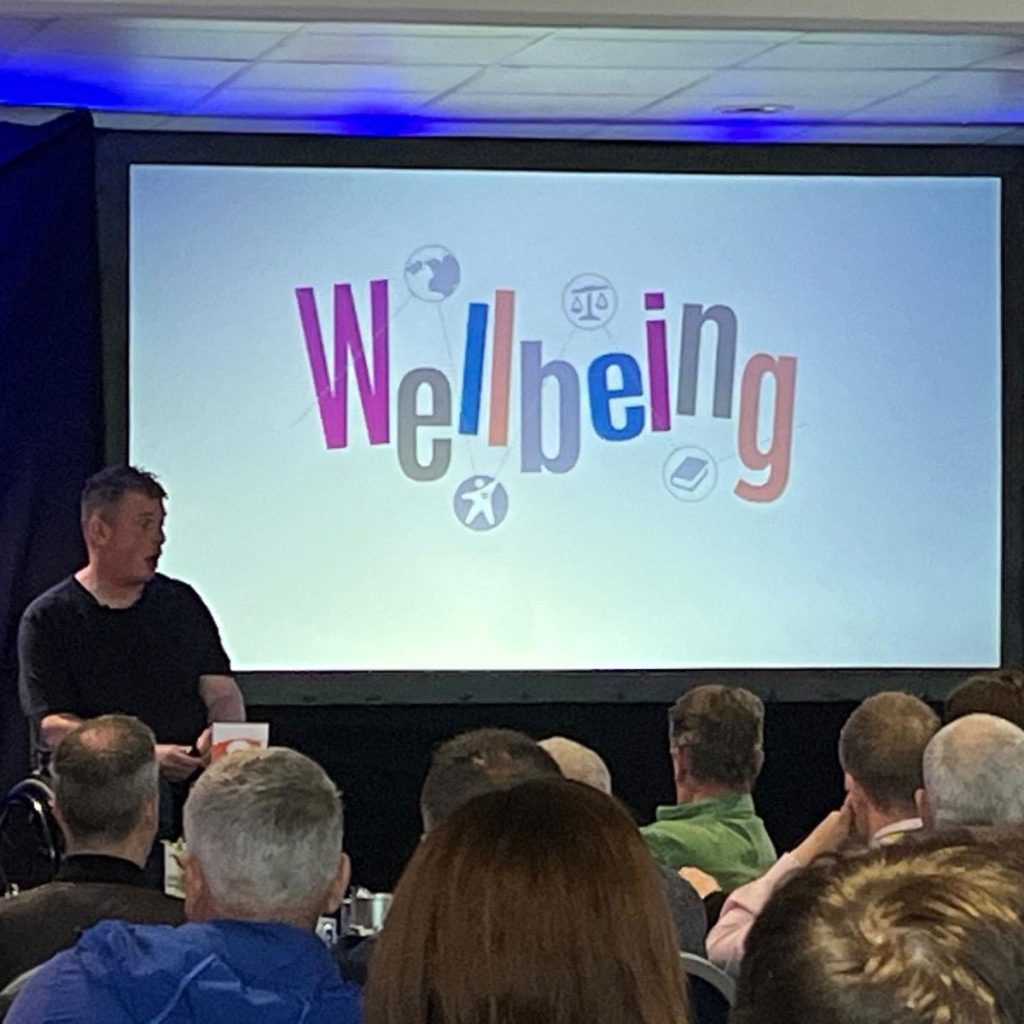
Jason is an advocate that people’s wellbeing determines what they do or don’t do, believing that you need to be aware of, and honest about how you’re feeling. Our feelings play a key role in our decision-making in every aspect of life. If you’re having a good day, you’re more likely to speak up or challenge something that isn’t right whereas if you’re in a bad mood or having a bad day, you probably wouldn’t bother and would just get on and do the job or, you might not even notice the hazard or danger in the first place. It’s not just about challenging an unsafe behaviour; it’s about being proactive. If you’re not in a fit state to complete a job you need to voice it before you even start by speaking to someone and explaining your situation, so you don’t even get anywhere near the ladder.
Challenging behaviour or actions can be hard and in the workplace it often doesn’t happen, however on the sports field we engage with our teammates regularly and challenge actions, performance and behaviour, so why not in the workplace?
What should companies and managers focus on?
Safety shouldn’t be focused solely on procedures, figures and statistics that you can measure. For many years, companies have put emphasis on their safety cultures. In certain industries, such as construction, where there are high staff turnover rates and where 5 years is considered to be a long time to be employed in one company, how can you build a long-term culture? It’s certainly difficult and, where high staff turnover rates exist, are they being looked at and questioned as to why they happen and how they can be reduced to improve the overall culture? Irrespective of the size of the company it takes a long time to establish a positive culture. So if a manager says ‘just get it done today’ it sets the tone for the future – this one comment can have a massive impact on poor behaviour. They’re essentially saying ‘crack on and get the job done no matter what’.
Wellbeing is an area incredibly close to Jason’s heart and he firmly believes that, rather than being reactive to situations, if people and organisations focus on the wellbeing of individuals and are more proactive, then accidents could be reduced. This needs to be coupled with creating a space where workers feel able to speak up both if they’re struggling personally or if they feel something isn’t safe. Companies providing Employee Assistance Programmes, access to charities such as The Lighthouse Charity and Andy’s Man Club, all provide much needed access for people where they can talk independently and confidentially and not feel judged.
Jason believes that wellbeing sits around the culture piece. Companies need to build an open and honest culture where people are empowered to speak up and aren’t scared to share concerns or report incidents. Feedback from a vested colleague can be powerful and when seen in a positive way it can help and inform others, whether that’s following an accident or after raising an issue.
Once in place, it’s so important to maintain a positive culture and be open to learning from mistakes when they happen. Jason’s business partner, Professor Tim Marsh says if you really want to succeed, you have to fail and then have open and honest conversations around failures as it offers an opportunity to learn. This is something companies need to focus on.
Building on the importance of mental health and wellbeing, Jason is developing ways to ensure that people are encouraged to be open. Working with Tim Marsh, Jason has developed the F-It score to move away from asking ‘are you ok?’ which only ever gets one answer, to look in more detail at how people are really feeling and understanding your team as individuals.
How are things now?
Over the last seven or eight years, Jason has been on a wellbeing journey which has helped him to start turning his life around. When initially starting to give presentations and talks on his experiences, Jason reflects that he was bitter about the accident and there was aggression in his presentations. Now however, Jason approaches his work wanting people to ‘be like me’, the Jason of today who wouldn’t make the decisions he did in 1993 and probably wouldn’t even have been on site that day. The creation of the F-It concept which looks beyond ‘are you ok?’ and places a real emphasis on how people really are, is an approach that Jason is currently sharing with organisations to empower people to make the right choice and be aware of their feelings and mindset.
What have been your biggest recent achievements?
Winning the best mental health initiative award at the Inside Out Awards for our F-It workshops with Proud2BeSafe has been a massive highlight for Jason this year. He also received a lifetime achievement award from the British Safety Council however raising awareness of the F-It concept has been the biggest achievement as it bridges the gap between safety and wellbeing. There are still some who don’t believe wellbeing even really exists and that it doesn’t influence safety at all so the F-It model could be a real gamechanger in how wellbeing and workplace behaviours are approached.
Tell us about Proud2BeSafe, what they can do to help companies and how can people get in touch?
Proud2BeSafe was set up in 2011 by Jason, with his daughter Abbi taking over in 2018 when Jason formed Anker Marsh with Professor Tim Marsh. Proud2BeSafe has expanded to have a portfolio of 10 accident speakers alongside a stable of wellbeing speakers. They also offer interactive performance sessions facilitated by actors to immerse and engage audiences and they facilitate the F-It workshop activities. Proud2BeSafe can offer a one-stop shop for everything a company needs to deliver a thought-provoking and interactive experience for attendees and can also organise events for organisations as they have recently teamed up with an events manager.
If people want to get in touch and discuss how Proud2BeSafe can help their businesses, they should contact Abbi Taylor (0800 8600 185 / [email protected]) or visit the website (www.p2bs.org). Abbi can also connect them with Anker Marsh which is an organisation Jason owns which provides assessment, consultancy and training support.